
Endangered Properties across Missouri
Angelo Logan 3 April 0 CommentsOakley Chapel A.M.E Church – Tebbetts, Callaway County
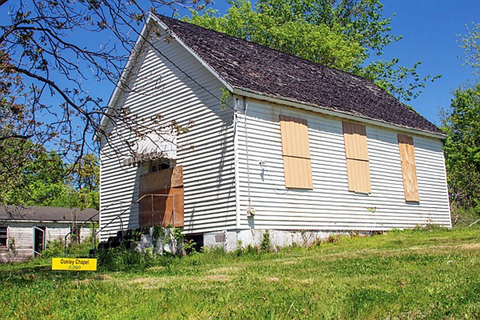
In 1878, during the aftermath of the Civil War, one acre of land in Tebbetts, Missouri was deeded to the “Trustees of the Colored Methodist Church” and became the site of Oakley Chapel African Methodist Episcopal (A.M.E) Church. While a large number of freed slaves left Callaway County following the war, a significant number remained and built churches that played integral roles in these communities. One example is Oakley Chapel, which during the 1920’s and 30’s was used as a school for Black children who were denied public educational access offered solely by “white schools.” Oakley Chapel was the first of three A.M.E. churches in the county and remains the only one standing. By the mid-twentieth century, the county’s Black population began to decline. As a result, the county’s Black churches either closed or consolidated with Oakley Chapel. Oakley Chapel continued to operate until the 2010s and has been closed since that time – Callaway County’s last active A.M.E. church. Oakley Chapel is a classic example of a vernacular rural church and has been carefully maintained over the years to preserve its pivotal role, not only as a place of worship, but as a significant gathering place and piece of Callaway County’s Black community and history. Tragedy struck in January 2021 when vandals broke into the building by breaking doors and extensively damaged the chapel’s interior. Original stained-glass windows were shattered, handcrafted walnut pews installed in 1949 from Cave A.M.E. Church were splintered, the pulpit and altar rail were destroyed, and the organ was overturned. Scorch marks on the floor remain from attempted arson. While the Tebbetts Community came together to temporarily board up the structure, Oakley Chapel remains vulnerable to deterioration and vandalism. A major concern is the chapel’s isolated location. MFA Oil Company has donated land for possible relocation of the church to a more visible location in town, along Highway 94 near the Katy Trail. Community leaders, residents, and the African Methodist Episcopal Church are exploring how moving the church could preserve its legacy and continue to tell the story of the resilient Black communities in Callaway County. It is hoped that listing Oakley Chapel as a Place in Peril will attract more volunteers and much-needed donors, as well as promote the restoration process and allow the community, historians, religious leaders and others to provide their assistance in preserving the property.
Missouri State Penitentiary Walls – Jefferson City, Cole County
The wall surrounding the former Missouri State Penitentiary (MSP) is one of the oldest standing architectural structures in Jefferson City. Sections of the wall are estimated to have been built between 1833 and 1835, just prior to the prison’s opening in 1836. Over the years, inmates have carried out maintenance on the walls, rebuilding sections using locally quarried stone. For more than 150 years the wall divided what was essentially two communities operating within Jefferson City — the prison and the city proper. Approximately 20 years ago, reports noted structural issues with the walls and tuckpointing was recommended; however, funding was not available to do the necessary repairs. In May of 2019 an F3 tornado ripped through the Capitol Avenue Historic District, causing a large section of the wall on Capitol Avenue to crumble. Dual ownership of the land by both the State of Missouri and the Jefferson City Convention and Visitors Bureau has further complicated fundraising efforts. Adding to the structure’s peril is the threat of redevelopment in the MSP area. While the idea of redevelopment is considered good for the community, there is also support for retaining the penitentiary walls as a reminder of the city’s history. Advocates for the Missouri State Penitentiary Walls hope that listing the property on the Places in Peril will help publicize the threat and prevent the structure’s removal, allowing it to be incorporated into future redevelopment plans.
Sara Lou Cafe – St. Louis City
The Sarah Lou Cafe was constructed in 1906 and is situated at the corner of Sara and St. Louis Avenues in the Greater Ville Neighborhood in the City of St. Louis. The building is one of four two-story, corner mixed-use buildings at this intersection, and is the only one of the four that is vacant.Owned by the Land Reutilization Authority, a state/city governmental agency, the non-profit group, Northside Community House, Inc., has just renewed one-year option to purchase. Generally, the façade of the building is in good condition. It has a terra cotta roof and bay windows overlooking the streetscape. Interior floors are solid and could be retained and refinished. Like many other properties of this caliber that have sat vacant, it has been stripped of copper, plumbing and most other items that might be sold for scrap. While the building’s interior is in generally good condition, the exterior is in dire need of stabilization due to un-boarded windows and deteriorating masonry walls. The Ville Neighborhood is representative of the resilience of African Americans in St. Louis to thrive and prosper in an age that was marked by racism and exclusion. In spite of adversity, the neighborhood has a rich history of African American education, business and art. The Café building is a historically significant landmark, gathering spot and family restaurant in St. Louis’s North City. Its loss would represent a loss of urban fabric, density and the rich history of this neighborhood. By listing on Missouri’s historic Places in Peril, it is hoped that Northside Community Housing, Inc, will garner further visibility and credibility in its case for support and will help raise the philanthropic dollars needed to rehabilitate this local landmark.
Leave A Comment